
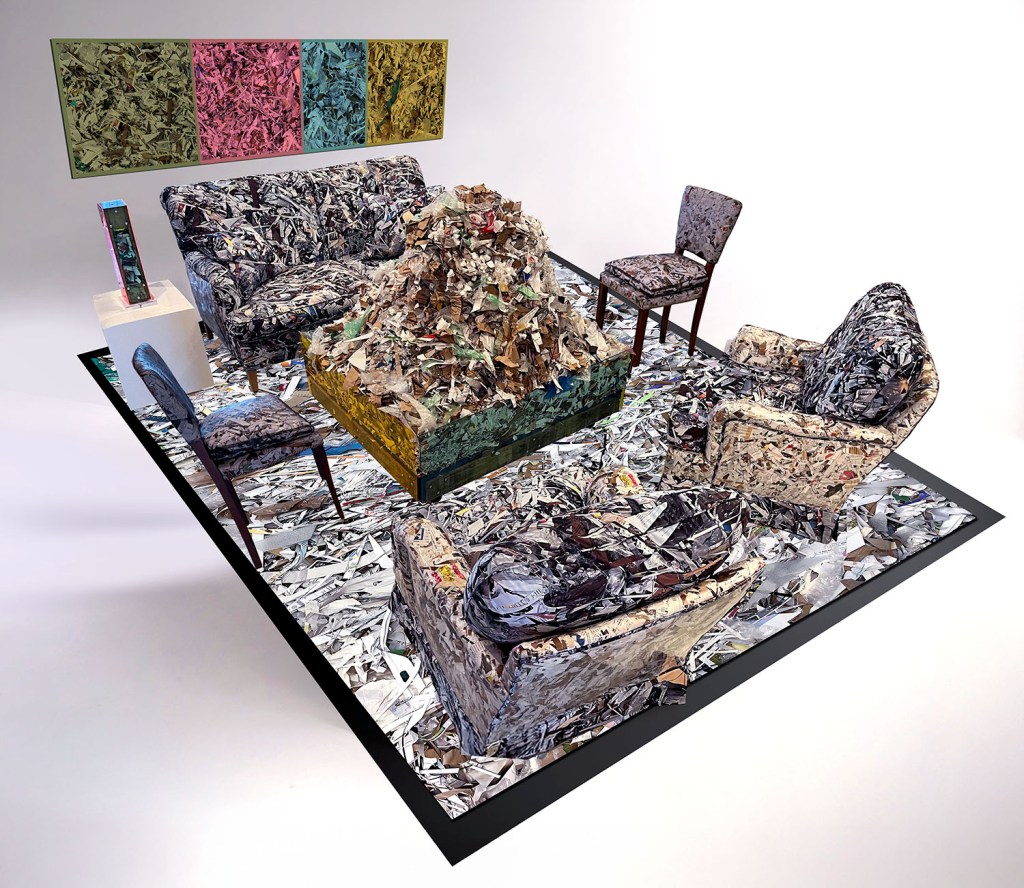
TrashFormations
2024 – 2025 | 120 x 156 x 156 | Used furniture frames, packing pallets acrylic, plastic, cardboard, paper trash, fabric, resin
INSTALLATION ESSAY
Transforming trash into something else while letting it be what it is, that is the fine line that I endeavor to straddle with TrashFormations. I guess that while so much of ‘art’ is focused on larger, global ideas as reflected in representations of our social concerns, identification and technological advancements, this work begins with keeping my thoughts and eyes on the ground or focused to the environment of the roadsides, alleyways and parking lots.
Not only do I want to interact and create with the common and discarded (as did the likes of Nevelson and Rauschenberg), but I also what to create beauty (as in the tradition of Manet and Mitchell). Ever since Duchamp in 1917 exhibited Fountain, creating art has moved beyond some considerations like form, style, color—to include context which is now recognized to be a part of the art experience. By removing trash from the dumpster, roadside, and garbage pile, I have transitioned the material–by ‘context’–to a new reference point. This allows the viewer’s gaze to be directed to a new understanding and actually ’see’ trash since most likely it has gone ‘un-seen’ till this moment.
My current creative process is a reflection of my 50 year career in interior design. My medium is the components of everyday domestic life: bed, sofa, chair, table and my studio assistants are upholsters, furniture makers, and graphic designers. My inspiration is fueled by the artistry of decades—even centuries– of amazing men and women who crafted from nothing the concepts of what a three dimensions space could be and then produced interior designs of profound significance in reflecting the moods and values of successive generations. This work required making countless decisions, having infinite patience and flexibility to manage the expectations of clients within the confines of ‘place’ and complicated budgets.
Historically this work is preserved in stately homes and palaces, the interior spaces of public buildings and institutions and many other ordinary places. The Metropolitan Museum in New York City acknowledges the importance of this work as well in exhibiting the Wrightsman Galleries. Without this creative contribution, every building would be, to some degree, an empty shell. The work I am presenting in TrashFormations is a continuation of this tradition, seeking to place within a contemporary context, interiors work that reflects our time, place and society while also manifesting something that is unexpectedly beautiful.
INSTALLATION DESCRIPTION
TrashFormations is an installation incorporating a number of different elements:
A note about the material used in this installation:
There are differing types of trash used to create this environment/installation. I collected overtime all the unwanted mail, boxes, catalogues, paper that came into my home studio and over the summer of 2024, I and my studio assistants shredded all this with an old fashioned paper cutter. Friends suggested that I use a mechanical shredder, but I opted for the mechanical one so as to have the experience of the duration and labor involved in shredding so much waste but also to put myself (and, at times, my unfortunate assistants) the process of meditation on waste and the amount of stuff which one person needs to confront in living in this waste producing society.
The other major daily source of the trash used in this installation is the by product of walking my dog daily in the industrial warehouse area where my studio is located. I found myself keeping my eyes down—making sure that Peggy didn’t snatch-up an unwanted treat from the streets and alleys. And in doing so came to ’see’ and notice all the trash that is beneath our feet, bikes and cars. This gaze allowed me to find the things that you are now seeing: moving pallets, rusted tin cans and shower pans, handmade sign stands in concrete and metal tube, 2×4’s and other wood pieces, cardboard, tin cans of all descriptions and discarded food containers. My favorite find was a completely flattened and finely rust-patinated metal bottle cap!
Sofa: The sofa was given to me by someone moving out of their house. It, like the other upholstered pieces of furniture, is upholstered in both a fabric printed with a photograph of shredded trash and the actual trash covered in clear plastic.
Pair of Chairs: These chairs were spotted at the local Good Will and transported to my studio by my boxing coach in her truck. One of the outer backs of a chair was sliced open exposing its innards. These chairs, as well as all the upholstered furniture in the installation, were expertly re-done by Shiekh Sahadat, his upholstery expertise is second only to his good nature.
Coffee Table with Objects: The coffee table was constructed from a blue painted wooden commercial moving pallet to which was affixed acrylic panels and covered with an acrylic box top. Inside the table is a sampling of the shredded trash which is fitting since it references the trail map printed on the top of the coffee table that show the outlines of the paths at Vista View Park in Davie FL, a park created on top of a garbage dump.The rusted bowl is a piece of metal picked up on a trip through the desert west and contains a collection of my favorite flattened and patinated bottle caps, sitting on top of an acrylic stand decorated with flattened Heineken bottle caps with their distinctive green color interior that here looks like exotic sea shells. Also on the table is a Trash Totem (a part of a pallet, filled with trash and covered with colorful acrylic panels); a vase with flower on a lucite stand (the vase is a small plastic container for lemon juice found in most grocery stores—which glows like fine Chinese porcelain—the flower is a rusty metal stem with a silk paper white flower found in my neighbors driveway); two clear beverage containers gotten in Marfa TX and filled with trash.
Two Side Chairs: These two chairs, one with an exposed wood frame and the other completely upholstered, were both found in the street, discarded and ready for the local bulk trash pickup. The seat on the one chair is covered in discarded black plastic screen mesh materials found in the dumpster of the local window replacement company.
Pair of Side Chairs. Originally starting off life as bar stools, this pair of stools became chairs by cutting off their legs and they are upholstered in trash and window screen black mesh.
End Tables with Objects: To the left of the sofa is an end table constructed from a moving pallet (the top) and a stand of rough concrete and metal tube found on the street. There is a piece titled ‘Bond Street Duct with Alligator’ composed of a rusted heating duct found in 1989 on Bond Street in NYC where I lived and a tiny plastic alligator found on the street; there is a beautifully rusted metal bottle and cap perfected smashed and found near the railroad tracks behind my studio which I think in another life could be a Van Gogh sculpture; and two aluminum cans filled with resin and positioned on a base in reference to Johns, Ale Cans 1964.To the right of the sofa is an end tale found in the junk pile and paired with the rusted shower pan discarded by the local plumbing repair warehouse. Next to it is a classical bar stool upholstered in trash and plastic given to me by a friend no longer wanting it. On top of the table is a piece I did in 1973 when I was a monk in a monastery. On Saturday afternoon I would go to the machine shop and fetch discarded parts from the trash pile and weld sculptures together from them. Even over 50 years ago I had an eye for trash, recognizing the possibilities it held and making something from it. There are other pieces I display there too: a flattened oil can though could read as a primitive mask; two abstract metal objects; a stack of beautiful rusted can.
Side Table at Pair of Chairs with Objects: The side table between the pair of chairs that I composed is reference to Frank Lloyd Wright’s, now demolished, Larkin Administration Building in Buffalo NY. It is made from a pair of weird 2×4 construction which became the legs and topped with the rusted out pan from a BBQ grille. On top is a vase made from three flattened plastic bottles set into a resin base titled, ‘The Bottles Walking’. The burlap flowers I found in a ditch in the back alley near my studio. They had been run over by trucks that park there.
Side Table next to Chair: This side table, composed of a found marble base, metal machine part, wood top. Titled’Trash Landscape Tableau’, it features a flattened can and can lid with a rubber glove (the hand of the artist) afixed to the bottom of the top panel.
Magazine Table: The magazine table is found wood objects decorated with colorful acrylic panels hold a stack of shredded Art in America magazines.
Art Piece over Sofa and the Pair of Art Pieces: All of these works are displays in various presentations of trash and, relying on context, together with composition, color and random arrangement of materials, become these expressive three dimensional textured ‘fields’. The frames on all three works are found in the garbage, as well, with the new black frames contributing a point of reference to ‘finished’ work.
Two Art Pieces leaning on Wall: To the left is TrashFormations, v 1.0, a C Print printed in a bright shine format, crushed, thrown out into the trash (that is a bit of performance art?), retrieved and flattened again to some degree. The final piece when framed has an unusual quality of looking like an acrylic sculpture of the sofa fabric print image. To the right is a framed piece of trash, salvaged and framed, saying to recycle this pizza box. I took this to heart and framed it as “Art”, ironic, recycled art.
Knapsack: This knapsack and water bottle were bought at the local Good Will and filled with trash. Its inclusion in the room (as well as the inclusion of the beverage cans sculptures) adds the aspect of a space, inhabited.
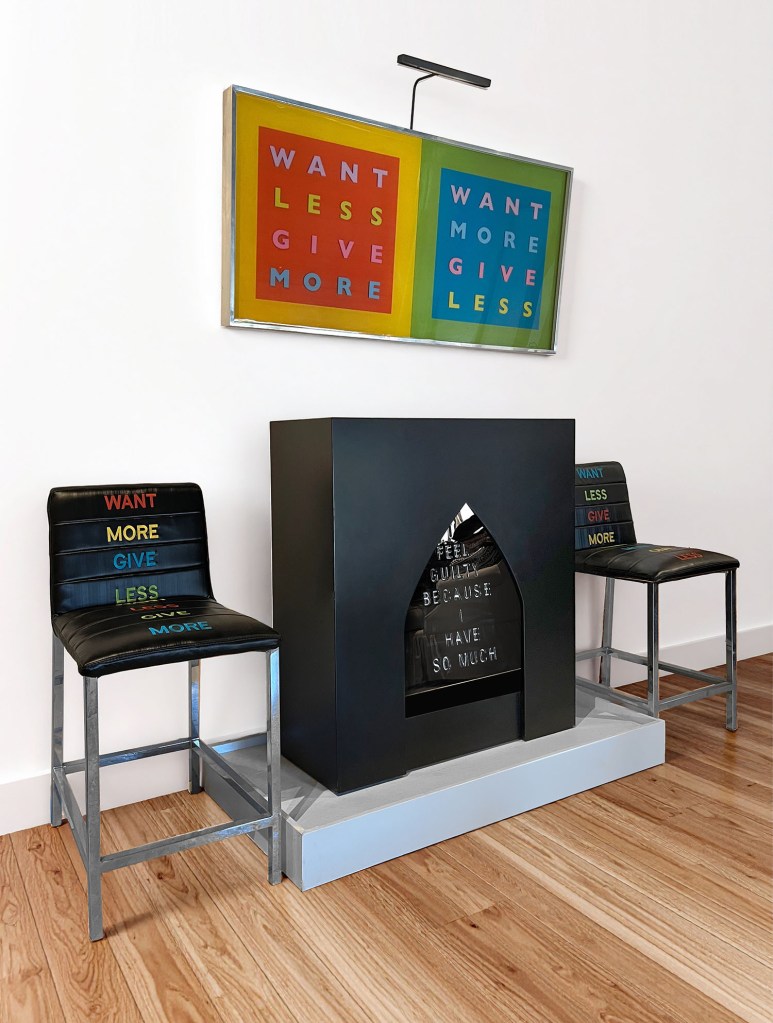
Want Less Give More
2019 – 2025 | 102 x 108 x 25in | Plastic letters, paper, lacquered cabinet, platform, plaster panels, bar stools, polished stainless steel with lighted acrylic panel
INSTALLATION ESSAY
The summer before the outbreak of Covid, I was in Guatemala visiting a non-profit that I had helped start in 2017. As is the case with many start up groups, money was scare even after almost three years of operation. It was during that trip, after visiting a health clinics and school high up in the jungle mountains surrounding the capital city, that I realized that I wanted to do more. I thought about it and decided to sell my house when I returned and live more simply in order to fund more fully the work in Guatemala.
I can’t say that conceiving of WANT LESS/GIVE MORE happened at the same moment as the decision to sell my house but certainly became a manifestation of a process—a transition—that I was undergoing. I feel that this piece does reflect a movement in my life which grew consistently in the years since I left my life as a monk in a Catholic monastery.
As we experience growth, first as children–through adolescence–to adulthood, we begin to recognize that true growth does not always feel good or make you happy. Child: burning their finger on a stove, Adolescent: first breakup, Adult: being in the first round of job layoffs—none of these experiences bring joy and encourage you want to sign up for “more growth”, but after taking time to process the moment, you can make changes that promote greater understand or perspective.
WANT LESS/GIVE MORE combines visual clues and plain messages to link the human condition with the diametric views of empathy and indifference, generosity and selfishness. This conversation has a moral aspect to it as well which is represented in religious traditions and values. But being truly present to all these thoughts opens up the distinct possibility of one’s descending into the mania of post-logical, thought circles and mental self flagellations that can eventually lead to a ‘dark night of the soul’ moment, where by you feel that there is
only darkness with no end to the suffering of the world. And we are faced with our individual inability to change that fact.
Sometimes you are left with one final question in the face of human inequity: WHY ME? At first glance, the questions seems to mean: why don’t I have more–but in reality, for those of us with more, the question is: WHY ME?—why do I have to be the one to see this inequity and now feel called to address it. WHY ME when you know that nothing you can do completely resolves the intrinsic injustice of life. WHY ME?
INSTALLATION DESCRIPTION
WANT LESS/GIVE MORE is an installation incorporating a number of different elements:
Back Wall Panels: These panels of discarded cardboard boxes that are reclaimed to be used as surface for the non-linear thinking and ‘mulling’ of the phrase, want less/give more. A multilayer process of hand writing (the finely printed lettering is the work of the owner of a Thai restaurant whose hand written menu boards are works of art themselves) and spray painting the words: want, less, give, more—together with successive plaster washes, gives the impression of language floating/disorganized which I the way I ’see’ it happening in my minds eye.
WL/GM Diptych: This framed piece of word or language art is reminiscent of the work of Jenny Holzer or Barbara Kruger as well as the introduction into historical painting of messages on banners and plaques. The direct communication of words is not only easy to read and understand the words themselves, but also hold a certain ‘poetic’ position as imagination sparks—igniting the mind to think beyond the words themselves.
Gothic Inspired Cabinet: A religious overtone is inevitable with the introduction of a Gothic arch. This architectural form inspires wonder when confronted in reality and is sued here to connect the words themselves with a moral tradition as expressed in the doctrines of most of the world’s great religions: that of being generous with others. There is no religious tradition that I know of that promotes selfishness or narcissism.
Pair of Bar Stools: By chance I spotted these bar stools at the local Habitat second hand store. Not that these in any way look like the bar school found in most bars and joints, the idea that people sit on these stools to converse with others happens everywhere: notice the bar stool at the kitchen island today—endless talking is encouraged even while cooking dinner.
Kneeler: This unassembled kneeler bought from Amazon is expressive of the posture of repentance. In giving at the installation in the kneeling posture focuses one’s attention on supplication: asking for something. In this instance is it forgiveness for not being committed enough to the idea of generosity in daily life or by nature of your personality or it is in supplication, pleading to be let go of the responsibility of the idea of giving more and wanting less. If art can do anything it can bring stir up in the unconscious the contradictions of existence.
Plastic Basket: I found this on one of my many walks with my dog Peggy. In retrieving it, I brought a new purpose to its existence: holding the opportunity for the viewer to express themselves by leaving their mark (words) on the installation.


 Adam von Dolle